Legal Operations Intelligence
From Spend Analytics to Legal Operations Intelligence

Key takeaways
- Because budgets and outside counsel spend are always a top priority, spend analytics tends to predominate. Service, cycle time, risk, and business outcomes are equally important focus areas that help drive the department's broader operational priorities.
- Business intelligence is the deterministic dimension of legal operations intelligence, and it and AI are each critical components of the platform. A governed metric is defined once, computed the same way every time, and traceable to its source records.
- The board, the executive team, finance, IT, and the business units all rely on legal's information, from risk and disputes to spend and service, and they increasingly expect it on demand.
- Business intelligence has to surface the indicators that signal an issue or call for action, whether they appear on a dashboard, trigger a workflow, or feed an AI tool.
- Metrics are defined over the same entities the ontology models, so a matter, a request, and an outcome mean the same thing in a report, a workflow, and an AI answer.
- Many technologies usually discussed as AI, such as data lakes, semantic layers, and knowledge graphs, are also advancing business intelligence, and most departments already license platforms that provide them.
Business intelligence is easy to take for granted. Most legal departments have reported on outside counsel spend for years, and while AI has dominated recent discussion, business intelligence has been advancing quickly too, often under AI's name. Data lakes that bring records from many systems into one place, semantic layers and semantic indexing that give data a consistent business meaning, and vector indexes and knowledge graphs that connect related records are frequently presented as AI technologies. Many of them are rooted in business intelligence and data management, and they change what a legal department can measure, how quickly it can answer, and where its metrics can be used.
The starting point is familiar. The quarterly report that reaches the general counsel shows outside counsel spend by firm and by matter type, produced by the e-billing platform without anyone commissioning a project. In the Thomson Reuters Institute's 2025 Legal Department Operations Index, 62% of departments said they routinely report total spend by law firm and 50% by matter type, and 60% have e-billing or spend management tools in place.
The questions put to the department now go further. As we described in the first article in this series, The New Mandate for Legal Operations, the remit of the general counsel and the legal department has broadened, and the business asks legal about service, risk, and value as well as cost. Departments have also begun to connect their metrics to automated processes, and legal technology announcements in May 2026 described products built for that purpose.
Business intelligence is the deterministic dimension of legal operations intelligence. It and AI are each critical components of the platform, because legal decisions require exact, repeatable outputs that a probabilistic system cannot supply. As expectations rise, business intelligence has to cover service, risk, and value alongside cost, answer on demand, and feed the processes that AI increasingly carries out. In our earlier article, Legal AI Is Not Deterministic, we drew the line between computing an answer and predicting one, and business intelligence is where the computing belongs.
This article builds on the second and third articles in this series. How to Build the Legal Operations Intelligence Platform described the platform across process, people, and technology, and The Legal Operations Intelligence Ontology described the model of entities and actions over which business intelligence metrics are defined. Business intelligence is also how the department computes the signals described in the first article: business impact, risk level, cost, timing, required skills, and resource availability.
Today's business intelligence is about more than spend analytics
Spend analytics came first for good reason. Budgets and outside counsel expenses are always among a legal department's top priorities, and the data behind them was standardized early. Invoices arrive in a defined format, matter types are coded against an agreed list, and the e-billing platform applies the same calculation to every firm. Spend metrics therefore predominate. In a November 2025 survey by ACC and Everlaw of 284 chief legal officers, general counsel, and legal operations professionals, 83% of teams said they track outside counsel spend, while 28% track time to resolution, 12% track outside counsel performance, and 9% track impact on business outcomes. Thomson Reuters' 2025 index shows a similar pattern, with service, cycle time, outcomes, and the value of technology each routinely reported by fewer than one in five departments.
Those other areas are now important business intelligence focus areas, because they drive the broader operational priorities legal leaders have set. As the first article noted, 47% of general counsel say they are more focused on improving service than on reducing cost. Service quality, cycle time, risk exposure, and business outcomes are the indicators that show whether that shift is taking hold, and they are the next stage of business intelligence for most departments.
As the need for broader business intelligence grows, departments are expanding their footprint and capabilities. Thomson Reuters reports that 37% of departments already have a dedicated legal business intelligence tool, in addition to the reporting done inside e-billing systems and on the enterprise platforms that companies already license, and many are working to make fuller use of the tools they have.
The field has also begun to recognize the work. LegalOps.com's RLLB 2025 awards included a "Data-Driven Legal Department of the Year" category, which recognized PayPal, Phillips 66, and Total Quality Logistics, and the published account of the judging noted that "The strongest entries demonstrated business outcomes backed by data." ACC's Legal Operations Maturity Model describes the advanced stage as one in which department leaders "directly access dashboards to filter data and answer questions", supported by a central data source and predictive analytics. Current expectations go further still, toward answers given on demand in plain language and toward metrics that feed automated processes.
Business intelligence turns legal operations data into decisions
For general counsel, legal departments, and legal operations analysts, business intelligence is the practice of turning the department's operational data into decisions. ACC defines the function, which it calls Metrics & Analytics, as "The system to collect, organize and use data to inform decision making and performance management". Forrester's Boris Evelson places business intelligence within what he calls the "data-to-decisions process", and wrote in April 2025 that "GenAI is not the end of BI".
The data foundation is the records the department already produces: matters, requests, contracts and their obligations, disputes and investigations, invoices and their line items, budgets, time, outcomes, and outside counsel engagements. From them, business intelligence produces quantitative metrics and KPIs, qualitative indicators such as risk ratings and satisfaction scores, trends, exceptions, forecasts, and answers to the questions people ask. Dashboards deliver some of those outputs, and so do a monthly report, an alert, an answer in a chat pane, and a threshold a workflow reads before it routes a request. Whatever the surface, the data point behind it has to mean the same thing everywhere it appears.
The profession's frameworks treat business intelligence as a standing function of the department, with software as one of its instruments. CLOC lists Business Intelligence among its Core 12 functions under the tagline "Make better decisions through data", ACC calls the function Metrics & Analytics, and the LegalOps.com reference model includes "Performance Analysis" among its practice areas. CLOC's Compass maturity tool, launched in May 2026, assesses business intelligence as one of its modules, alongside financial management and vendor management.
In the terms of the second article, business intelligence spans process, people, and technology. Someone owns the definitions, someone asks the questions, tools deliver the answers, and the answers change what the department does. Departments that buy tools without settling ownership often find that the resulting reports go unused. Business intelligence is also the reporting capability among the four described in the first article, and it supports the other three: service delivery, sourcing, and knowledge management.
Business intelligence supports the full scope of the general counsel's contribution
The general counsel's contribution to the business extends well beyond the legal budget. A general counsel who reports to the chief executive and attends board meetings reports on the company's legal risk, significant disputes and investigations, regulatory developments, transactions such as mergers and acquisitions, compliance, and the performance of the department itself. Each of those reports rests on data the department holds, and each has to stand up to questions from people who were not involved in producing it. Business intelligence is what allows the department to answer those questions with evidence.
The stakeholders who rely on that information have multiplied. The board and the executive team need a clear view of exposure and risk. Finance and procurement have scrutinized legal spend for a decade, and they need forecasts and accruals they can plan against. In our experience, IT increasingly co-funds legal technology, which gives the technology leader a stake in how the department models, secures, and reports its data. Business units want to know where their requests stand and when they will be done, and the audit committee draws on legal's information as well. As the first article described, many executives outside legal do not yet see the full contribution legal makes, and the Thomson Reuters Institute's advice is to present metrics in terms the business already uses, such as legal spend as a percentage of revenue. In our earlier article, Breaking the Silo Between Legal, Finance, and the Business, we discussed how departments can improve transparency with these stakeholders.
These stakeholders increasingly expect answers on demand. ACC describes legal expertise as "integrated into business planning during the inception of projects rather than at the point of crisis", so the business puts its questions to legal while decisions are still being made, and it wants the answer in the meeting rather than in next week's report. That calls for metrics that cover service, risk, and value as well as cost; answers in plain language, inside the tools people already use; and answers produced without days of manual preparation. Legal technology vendors are responding. Around the CLOC Global Institute in May 2026, several announced natural-language questions over spend, rate, and matter data, and Legal.io's chief executive, Pieter Gunst, put the case directly: "In-house teams don't need another dashboard. They need answers." Those answers should draw on governed definitions agreed in advance, so that the figure a person gets by typing a question is the figure the dashboard would show. In our earlier article, The UX That Legal IQ Requires, we discussed why an answer a user can drill into and act on is a different product from one that only prints.
Business intelligence supports the general counsel's contribution across several areas. The figures in the examples that follow are illustrative.
Commercial risk. Consider a business unit leader who asks whether the company should keep negotiating a liability cap that counterparties resist, or accept the standard term and price the risk. The department answers from its own records. Over three years, 140 contracts carried the negotiated cap and 90 carried the standard term, the disputes that reached litigation split six to five between the two groups, and the negotiated cap added a median of 11 days to the cycle.
Emerging risk. Risk shows up in the department's records well before it appears as a claim, a regulator's letter, or a write-off. The first article described the proactive and reactive sides of legal operations, and business intelligence is how the department carries out the proactive side. In our earlier article, From Reactive to Predictive, we described the same progression in maturity terms. Consider a department with 200 open matters that reviews a risk view each quarter. One business unit produces two fifths of the employment disputes with one sixth of the company's headcount. Twelve matters show budget drift of more than 20% by month three. Two contract clauses appear in most of the disputes that reached litigation. The department responds with a review with the unit's leadership, a reserve adjustment on the twelve drifting matters, an intake rule that routes that unit's requests for early legal review, and a change to the contract template. Each action is recorded against the same entities the indicators were computed over, so the next quarter's view shows whether the concentration moved, whether drift fell, and whether the clauses stopped appearing in litigated matters.
Outside counsel spend. Spend analysis by firm, matter type, and phase shows which work costs what, and allocation analysis extends the question to which work belongs inside the department, which belongs at a firm, and which timekeeper level should carry it. Rate and staffing analysis tests whether the rates a firm quoted are the rates it billed, and budget-to-actual tracking catches drifting matters while there is still time to intervene. In Thomson Reuters' 2025 index, 63% of legal operations respondents said they use data analytics to identify cost savings, against 29% of general counsel respondents, so the analysis has to reach the general counsel to inform panel decisions. Consider a department that compares three years of wage and hour defense work across its panel. The first of two firms bills a median of US$68,000 per matter with 40% of its hours at partner level. The second bills US$91,000 with 22% at partner level and resolves matters in two thirds of the time. The comparison names no winner, but it gives the department a question to put to both firms and a basis for pricing a fixed fee on the next ten matters of that type. In our earlier article, The $20B Blind Spot, we described what the absence of that visibility costs a department.
Intake and service. Intake is the department's front door, and it is where service data begins. Request volume by business unit and type, time to first response, cycle time split between the time legal held a request and the time it sat with the business, the share resolved through self-service, and the route each request took are all recorded at intake or nowhere. Consider a team that instruments its front door for two quarters. Of 640 requests in a quarter, 38% are non-disclosure agreements and vendor contracts below a US$50,000 threshold, and their median cycle time is six days, four of which are spent waiting for the requester to answer a question. Two business units account for 44% of the volume. With those data points, the department can publish a self-service path for the lowest-risk requests, route the two heaviest units' requests to a named reviewer, and discuss the four waiting days with the business.
Resources. Companies are asking legal departments to absorb growing workloads without adding people. Gartner, as reported by Lawyers Weekly in July 2026, found that 56% of legal departments anticipate a headcount freeze or reduction in 2026. Under that constraint, the department builds its resource case from request and matter data. Consider a department of fourteen lawyers that records 2,400 requests in a year, up 18% on the prior year, with the commercial contracts group absorbing 60% of the growth while its median cycle time rises from five days to nine. The same records show that 30% of that group's volume falls below the value threshold at which a lawyer changes the outcome. The resulting case asks for one paralegal, a self-service path for the lowest-value requests, and a date by which both are in place, and it carries the metrics that will show next year whether the decision was right.
The structure of a governed business intelligence model
Every one of those examples depends on metrics that hold steady, whether the figure is a cycle time, a risk rating, a litigation reserve, or spend against budget. When the general counsel quotes a figure to the board and finance quotes a different one from the same records a week later, the discussion moves from the substance to the data.
A governed metric is deterministic. It is defined once, governed by someone who owns the definition, computed the same way for every user, and traceable to the records behind it. When an assistant or an agent needs a matter count, a cycle time, an exposure figure, or spend against budget, it calls the governed metric rather than generating a figure with a language model.
Legal decisions turn on exact outputs. A settlement authority, a budget approval, a privilege call, and a regulatory deadline each have a right answer that does not vary between runs, and the same holds for spend against budget, cycle time, and rate compliance. AI does the work that tolerates variation well, such as classification, extraction, summarization, and drafting. The platform needs both.
A governed metric also depends on agreed definitions of the things it measures: a cycle time for requests requires the department to agree what a request is, which events start and stop its clock, and where its record lives. The ontology described in the third article supplies those entities: matters, requests, contracts, obligations, disputes, invoices, and firms, together with the actions taken on them and their outcomes. Business intelligence metrics are defined over the same entities. When the cycle time metric counts requests as the ontology defines them, "request" has one meaning in the quarterly report, in the routing rule a workflow applies, and in the answer an assistant returns.
Business intelligence measures, compares, and surfaces the exception: the matter running over budget, the business unit whose disputes are rising, the firm whose effective rate moved from one year to the next. The ontology is where someone acts on that exception, and where the action and its outcome are recorded against the same matter or request. Those records become the next period's inputs, so the metric that surfaced the exception also shows whether the response worked.
Analysts outside legal describe the same structure. Forrester's Boris Evelson wrote in July 2026 that organizations should "treat semantic layers and context graphs not as analytics features but as enterprise infrastructure for data, analytics, and AI". A semantic layer is where governed definitions live. The Apache Ossie specification, which entered the Apache incubator in June 2026, describes itself as "an open specification for both semantic layer and ontology", and Forrester in August 2026 defined a context layer that "combines business semantics and governance of semantic layers with the ontological modeling of knowledge graphs". For a legal department, the convergence means that building a semantic layer and building an ontology are complementary.
Governed definitions also make answers more reliable. In an April 2026 benchmark by dbt Labs, raw text-to-SQL on a well-modeled project scored 84.1% and 90.0% for two models, against 100.0% and 98.2% for the same questions answered through the semantic layer. By the same vendor's measure, text-to-SQL accuracy on its full question set rose from 32.7% in 2023 to 64.5% in 2026, so the gap is narrowing. The lasting difference is how each approach fails. Through a semantic layer, failure appears as an error message, while with text-to-SQL it can appear as a plausible wrong answer, and a wrong figure that looks right is far harder to catch. Legal products are adopting the same principle. Brightflag's description of its MCP connector says that answers "come from your actual Brightflag data, not estimates, not model-generated approximations".
The structure forms a closed loop. The department's records are the inputs, and governed metrics are computed from them. A metric surfaces something that calls for a decision, the decision produces an action, and the action and its outcome are recorded against the same entities, which makes them inputs for the next period (Exhibit 1).
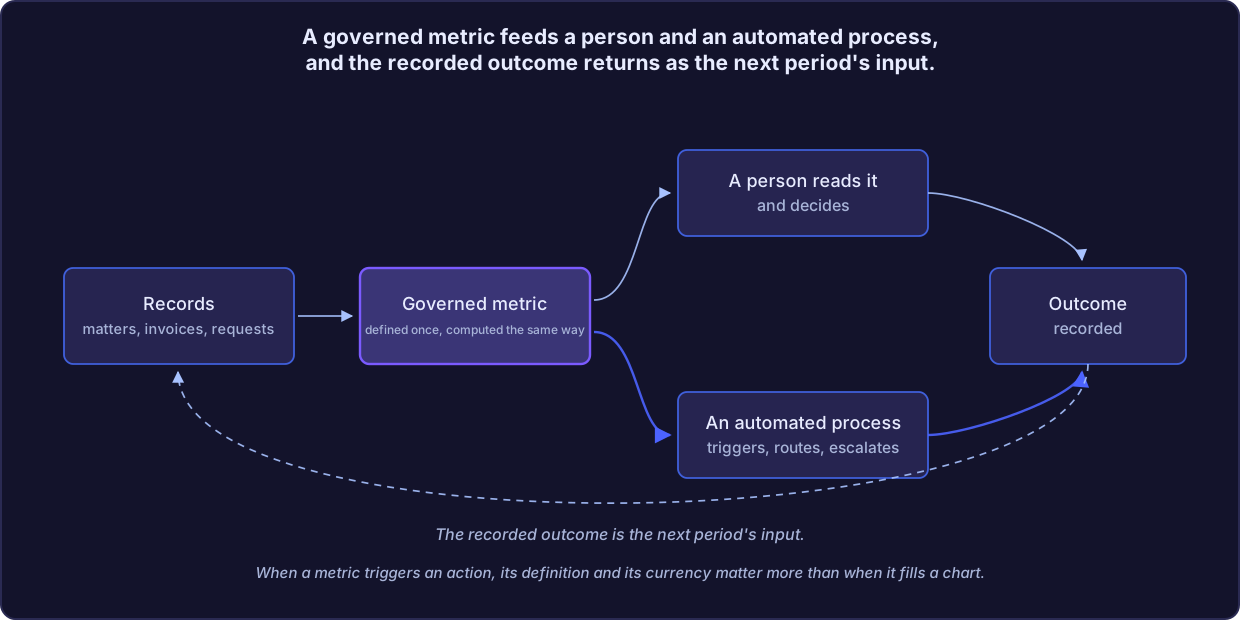
Business intelligence as report, trigger, and input to AI
Business intelligence now serves three purposes, all drawing on the same definitions:
- Reporting. Dashboards, scorecards, and reports through which people review the department's performance, interpret it, and decide.
- Automation. Metrics and thresholds that trigger workflows, send notifications and alerts, and route or escalate work without anyone opening a report.
- Deterministic data for AI. The exact figures an assistant or agent retrieves when it needs a number, rather than an estimate it generates.
Automation is the fastest-growing of the three, and legal technology vendors announced products built for it in May 2026. Wolters Kluwer described an invoice review agent that "identifies non-compliant invoice line items and automatically implements adjustments", with the adjustments auditable and reversible. Checkbox described agent actions that create a populated matter and start the right workflow from an incoming request, and matter status set from message activity, so that reporting separates "time spent by legal from time spent waiting on the business". There, the automation maintains the status, and the metric computed from it answers a question the department could previously answer only by asking the lawyer who handled the file. The Gartner intake forecast cited in the first article, that by 2029, 60% of legal departments will use AI to capture every request and answer half of them without human intervention, describes the same arrangement at scale. An intake system that answers half its requests has to decide which half, and that decision rests on a metric.
Business intelligence also measures AI itself. As the second article noted, 83% of in-house legal leaders in Axiom's 2026 survey said they cannot yet measure whether their AI spending is working. Demonstrating the return on AI investment starts with defining the metrics that will show it.
The pattern that works across all three purposes is the one described in our earlier article, Legal AI Is Not Deterministic: probabilistic surfacing paired with deterministic enforcement on the same record. An agent can read an invoice and propose an adjustment, while the rule that decides whether the adjustment falls within the billing guidelines is a governed calculation applied the same way every time. When a metric only filled a chart, a disagreement about its definition cost a meeting. Once the metric triggers an action, a definition that two systems compute differently produces a wrong action, and that action stands on the record.
Building the modern business intelligence capability
The examples in this article share three preconditions: consistent definitions of a matter, a request, and an outcome; data that reaches the metric without someone assembling it from separate systems each time; and a place to act on what the metric shows.
ACC's maturity model names the first two as the hurdles departments meet. At the early stage it describes "Uneven integrity/cleanliness of data". At the intermediate stage it describes metrics "generated through manual synthesis of data from disparate systems", the stage at which each new question requires fresh manual work. ACC's account of the Everlaw survey puts figures against the same barriers: lack of time or resources at 57% of teams, data scattered across systems at 50%, limited tools for automation at 43%, and difficulty aligning metrics with business priorities at 29%.
Tooling is rarely the binding constraint. In the Thomson Reuters figures, more departments rate their dedicated business intelligence tool as underutilized (21%) than as valuable (16%), which is what happens when a tool arrives ahead of the definitions and data it needs. In our earlier article, The AI Readiness Gap in Legal Departments, we described data readiness as a shared precondition for business intelligence and AI.
The enterprise platforms most companies already license have advanced considerably, and much of that progress is directly useful to a legal department. Microsoft Fabric brings data from many systems into a single lake, and its Fabric IQ capability adds ontologies alongside semantic models; in Microsoft's words, "Semantic models and ontologies work together". Power BI data alerts can trigger Power Automate flows, and Fabric Activator rules can fire on report visuals, turning a metric into a trigger. Conversational analytics is now generally available across the major platforms, including Microsoft's Fabric data agents, Salesforce's Tableau Agent, and Databricks' AI/BI Genie. Google's Looker has added agentic workflows that can run an analysis automatically when a metric crosses a threshold, and Forrester describes agents that "can deliver alerts when thresholds are crossed, anomalies emerge, trends shift, or opportunities arise".
These capabilities differ in how strictly they keep to governed definitions. Microsoft's documentation for the standalone Copilot experience in Power BI, for example, says that it "uses the measures and other data fields in your semantic model (or even creates new DAX calculations)". A department that cares about repeatability needs to know when an answer comes from a governed metric and when it comes from a calculation generated on request.
The second and third articles in this series address the remaining preconditions: how a department builds the capability across process, people, and technology, and the ontology over which metrics are defined and actions are recorded. Where the records physically sit is a separate question from whether anyone governs the metrics over them, and metrics can be defined over records held in the platform or in the third-party systems a department already runs.
Conclusion: business intelligence remains a cornerstone of legal operations intelligence
Business intelligence is well established in legal departments, and it remains a cornerstone of legal operations intelligence. What is asked of it has grown. It has to cover service, risk, and value as well as spend, support the full scope of the general counsel's contribution to the business, and supply exact figures to the dashboards, workflows, and AI tools the department relies on. The technologies advancing it, from data lakes to semantic layers and knowledge graphs, are already within reach of most departments. Together with AI, business intelligence is a critical component of the platform, and it is defined over the same entities as the ontology.
The practical instruction for a legal operations leader is to govern first the metric that is about to trigger an action. In most departments that metric sits at intake, because intake is where service data begins and where metrics and automation meet soonest. Write down what a request is, when its clock starts and stops, which system holds its record, and who owns the definition when the business asks to change it. Then put the rule in place.
A department that takes those steps in the reverse order tends to find out later, when an intake rule has routed or escalated matters on a cycle time that two systems compute differently, and no one can reproduce the figure behind a recorded action when asked why it was taken. Settling the definitions before the first rule runs avoids that problem.
The fifth article in this series takes up knowledge management, which supplies AI with the context it needs in the same way that business intelligence supplies exact figures. The two rest on the same foundation, and a department that has settled its definitions for one has done much of the work for the other.
Sources
- Thomson Reuters Institute, 2025 Legal Department Operations Index
- Association of Corporate Counsel and Everlaw, 81% of CLOs Say GenAI Accelerates Legal Work
- LegalOps.com, Running Legal Like a Business awards 2025
- Association of Corporate Counsel, Legal Operations Maturity Model 2.0
- CLOC, Core 12 functions of legal operations
- CLOC, Compass maturity platform
- Forrester, Build Meaning Before Machines
- Forrester, Key Takeaways From The Forrester Wave: Business Intelligence Platforms
- Legal.io, CLOC Global Institute 2026 announcement
- Lawyers Weekly, on Gartner's outlook for legal departments
- Apache Ossie, entering the Apache incubator
- Axiom, 2026 Legal AI Survey
- Microsoft Learn, What is Fabric IQ?
- Google Cloud, How Looker's semantic layer enhances generative AI trustworthiness
- Microsoft Learn, Copilot chat with data in Power BI
- Gartner, forecast for AI-enabled legal intake
- Checkbox, agent actions for matter creation and status updates
Related reading:
For questions or comments about this article, contact Ralph Schroeder, Founder and CEO of Spaarke, at ralph.schroeder@spaarke.com, or visit spaarke.com.
Continue reading



Want to see how it works?
Get access